The November 7 Anomaly and the Space of the Briefcase
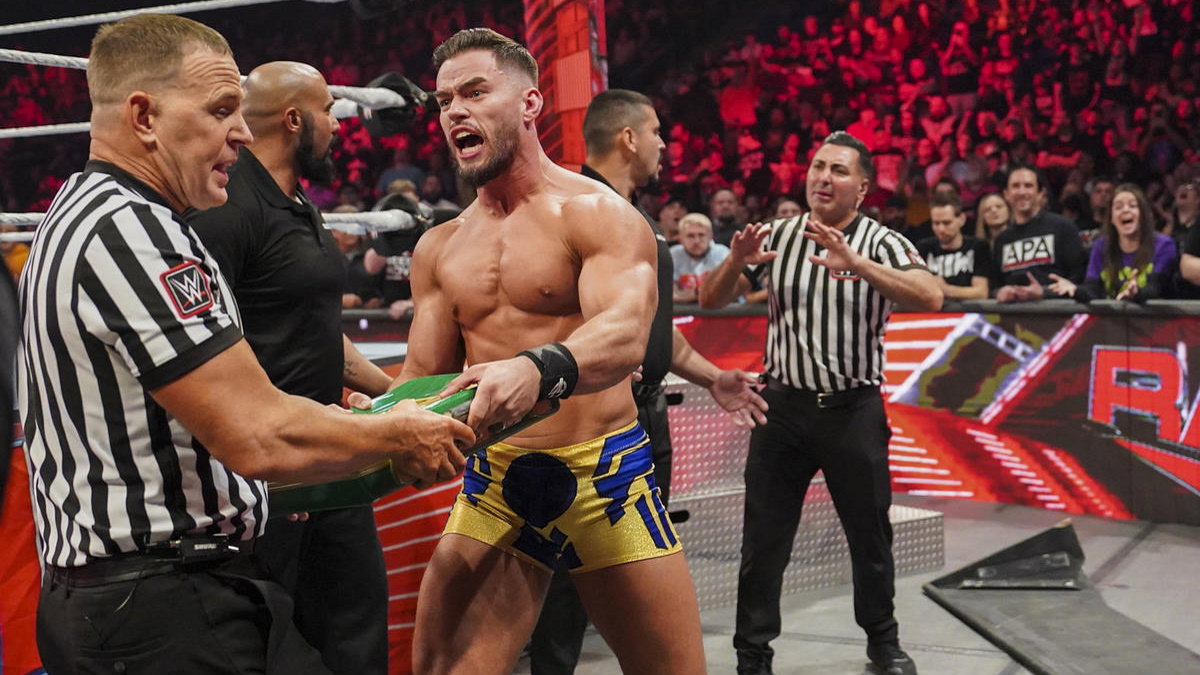
Exactly 128 days after winning the Money in the Bank contract on July 2, 2022, Austin Theory walked down to the ring on Monday Night Raw and did something no briefcase holder had ever done in the 17-year history of the stipulation: he cashed in on a mid-card title. The resulting bout lasted exactly 4 minutes and 58 seconds, ending in a pinfall loss for Theory after outside interference and a curb stomp from Seth Rollins.
This was not a standard title match. It marked the beginning of a tactical shift in how WWE treats its premium booking assets. In the summer of 2022, the transition of creative control from Vince McMahon to Triple H initiated a complete re-evaluation of the briefcase's place on the card.
Historically, the contract was an almost guaranteed ticket to a world title. But the new management immediately began recalculating the asset's value. The subsequent booking decisions showed a clear departure from the historical model.
In a recent interview on Logan Paul's Impaulsive podcast on July 2, 2026, Theory admitted he felt robbed by the execution of the storyline. His comments highlight a deeper tactical tension: the conflict between long-term, protected world championship reigns and the chaotic, short-term booking requirements of the briefcase. Theory's cash-in was not a failure of ring execution, but a mathematical liquidation of an asset that no longer fit the company's main-event balance sheet.
The Historical Math of the Briefcase
McMahon's Cash-in Sprint Metrics
To understand why Theory's cash-in was such a departure, we must examine the historical baseline. Since the inaugural ladder match in 2005, the men's Money in the Bank briefcase has maintained a success rate of 70.37%. Out of the first 27 cash-in matches, 19 resulted in successful championship changes.
The remaining attempts ended in direct failures or pre-cash-in losses. When including the women's division, which boasts a flawless 100% success rate, the contract remains one of the most protected devices in wrestling.
Historically, the briefcase was used as a shortcut to bypass traditional, long-form booking cycles. Under Vince McMahon, the average successful cash-in match lasted less than two minutes. The booking targeted injured babyface champions to generate maximum heat.
Edge's first cash-in on John Cena in 2006 occurred after Cena survived a grueling 28-minute Elimination Chamber match. Similarly, Kane cashed in on Rey Mysterio in 2010 in just 54 seconds. These quick strikes established the briefcase as an instant star-maker.
The Reigns Ceiling
However, this high success rate depended on a highly volatile championship picture. Between 2005 and 2021, frequent title changes allowed the briefcase holder to easily slot into transition roles. That mathematical flexibility disappeared when Roman Reigns consolidated the world titles.
Reigns established a dominant reign that eventually spanned over 1,300 days. A champion who rarely defended on television made the traditional cash-in mechanic nearly impossible to execute without disrupting multi-year story arcs. As WrestleTalk reported, Theory wanted the payoff to be a much larger moment.
The United States Championship Liquidation
Because Reigns could not lose the world titles, Theory's briefcase became a narrative anchor. The new creative regime had to find a way to remove the briefcase from the equation. The solution was to target the United States Championship, a decision that carried severe statistical consequences.
By targeting a secondary title, the contract was instantly devalued. The briefcase had never been used for a mid-card title, as doing so signals that the holder is not a main-event player. Cashing in on a mid-card title exposed a lack of long-term planning for the holder.
Cashing in on Seth Rollins after Bobby Lashley's beatdown made Theory look statistically weak. The match on November 7, 2022, was a tactical retreat rather than a showcase. The entire segment functioned as a rapid scramble to remove the briefcase from television.
Here is how the match length of Theory's cash-in compares to other failed cash-in matches in history. These figures illustrate the varying tempos of booking failures:
- Baron Corbin (2017) — 6 seconds
- Austin Theory (2022) — 4 minutes, 58 seconds
- Drew McIntyre (2024) — 8 minutes, 44 seconds
- John Cena (2012) — 11 minutes, 15 seconds
- Damien Sandow (2013) — 13 minutes, 46 seconds
Theory hit his A-Town Down finisher and went for the cover, but Lashley's run-in and subsequent Hurt Lock on the floor completely neutralised Theory. By the time Rollins hit the Curb Stomp to retain, Theory's win-loss record and main-event momentum had been severely compromised. According to a report by WrestlingNews.co, Theory felt cheated of his payoff, wanting a more significant resolution to his run with the contract.
During his Impaulsive appearance, Theory detailed this creative constraint. He focused specifically on the missed potential for a major payoff.
"In that moment, I wanted to say the same thing to him, you know, because in a way it's like he was a Vince guy as well. Not in a way—he was. But I felt like there could have been a moment. I knew we weren't going to get the title off Roman, but even just building it to seem like, 'Oh, here we go.' And then, you know, I could lose to him, whatever, but just give it more of a payoff because it felt cool, man. Like, I did a lot of cool things with it."
Theory's analysis is correct. A failed cash-in against Roman Reigns at a premium live event would have elevated him far more than a mid-card failure on Raw. That main-event loss would have established him as a legitimate challenger, whereas the United States title attempt functioned as a quiet cleanup.
The Diverging Pacing of the Triple H Era
The Long-Hold Asset
Under the current regime, the briefcase's pacing has diverged from historical norms. Compare Theory's hold time with subsequent winners like Damian Priest, who held his contract for 281 days. Priest's cash-in at WrestleMania XL was timed to the second, lasting only nine seconds after a CM Punk beatdown on Drew McIntyre.
The Narrative Engine Failures
Conversely, Drew McIntyre's failed cash-in at Money in the Bank 2024 lasted 8 minutes and 44 seconds after he inserted himself into a singles match. This failure was not a comedic setback, but a key plot point in his ongoing feud with CM Punk. Theory did not have the benefit of a long-term personal rivalry to cushion his fall.
Theory was a performer caught in the middle of a corporate transition. As a hand-picked project of the former chairman, his creative value was recalculated under new leadership. The cash-in was not a storyline payoff; it was a storyline termination.
The Quantitative Cost of Creative Transition
The fallout from this booking decision can be measured in Theory's subsequent performance metrics. Although he eventually reclaimed the United States Championship at Survivor Series 2022 in a triple threat match, his singles match winning percentage dropped significantly in the six months following his failed cash-in. The briefcase, which had once been a platform to elevate talent, became a symbol of creative uncertainty.
The larger cost was borne by the stipulation itself. The booking power of the ladder match depends on the audience believing that the contract represents a guaranteed world title. When the briefcase is used on secondary titles and lost in under five minutes, the stakes of the entire event are diminished.
Theory's admission is a rare confirmation of the friction that occurs during corporate transitions. The dented briefcase in his office remains a physical reminder of a rough night with Brock Lesnar. More than that, it stands as a monument to a booking regime that preferred to liquidate a main-event asset rather than design a long-term payoff.
Read Next
- Vince McMahon sold WWE to save himself, and Austin Theory paid the price
- Why WWE's Oba Femi swerve exposes Triple H's worst creative habits
- Netflix turned Bron Breakker into a pixelated joke at Night of Champions
- Why WWE is ready to pounce on Eric Young after his shock TNA release
- 💰 WWE Money in the Bank 2026 — Full Coverage Hub