Carnage at Capitol Wrestling Center leaves top stars sidelined
The second night of NXT Revenge didn't just provide a shift in the championship rankings; it left the medical room at the Performance Center overflowing. In a night defined by high-risk spots and a notably more aggressive in-ring style, two of the brand's most critical assets, Joe Hendry and Sol Ruca, are facing significant time away from the ring following a pair of brutal finishes that have sent shockwaves through the locker room.
The most immediate concern involves Joe Hendry. In what was billed as a standard singles contest against Keanu Carver, the match ended in a rare referee stoppage after Carver unleashed a series of targeted, high-impact strikes to Hendry's neck and base of the skull. Hendry was rendered unconscious in the ring, forcing the official to call for the bell at the 14-minute mark. Medical staff were seen stabilizing Hendry's neck before he was transported to a local medical facility for further evaluation.
This isn't just a storyline pivot; it's a calculated physical write-off for Hendry as he prepares for a full-time transition to the Raw roster. However, the choice of a neck-related injury angle is always a gamble. By utilizing a referee stoppage rather than a clean pinfall, NXT creative has managed to protect Hendry’s aura while simultaneously establishing Carver as a legitimate threat. The problem is the optics. Seeing a crossover star of Hendry’s magnitude left in a heap after basic strikes felt jarringly final for his NXT tenure.
Sol Ruca's balcony plunge and the Zaria betrayal
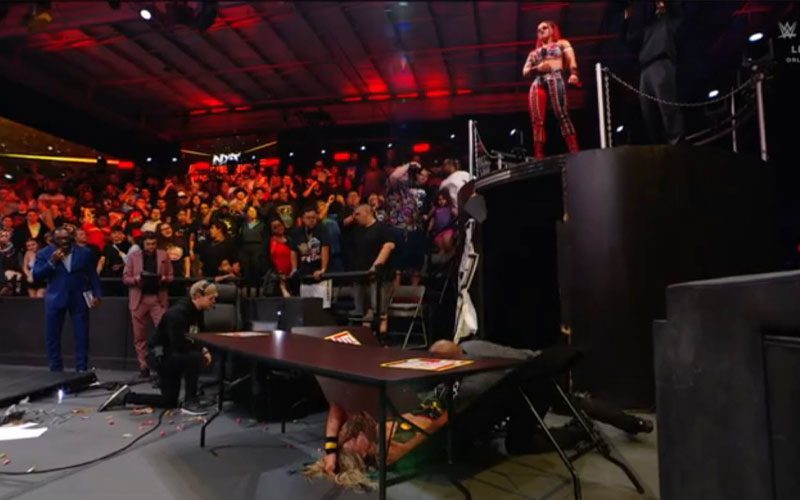
While Hendry’s situation carries the weight of a brand transfer, Sol Ruca’s status is arguably more dire for the NXT women’s division. During her Last Woman Standing match against Zaria, Ruca was thrown from a balcony perch, crashing through a table on the floor below. The fall, estimated at over 12 feet, appeared to result in significant impact to her lower back and ribs. Zaria’s feigned embrace before the shove added a layer of psychological cruelty to a spot that was already physically terrifying.
Ruca is no stranger to the shelf. In April 2023, she suffered a torn ACL that cost her nearly a year of her prime development. This latest incident, coming just as she was being positioned as the top babyface challenger, feels like a massive step backward. Medical observers noted that Ruca was unable to put weight on her left side as she was assisted to the back. If there is spinal compression or a hip fracture involved, we could be looking at another 6 to 9 months of recovery time.
The decision to book a balcony bump for a performer with a history of major ligament issues is questionable at best. Ruca’s game is built on explosive athleticism—the Sol Snatcher requires perfect knee and back stability. Landing flat on a table from that height sends a shockwave through the musculoskeletal system that even the best-trained athletes struggle to absorb. It was a spectacular visual, but one that might have cost NXT its most promising female high-flyer during a critical ratings period.
Myles Borne and the steel step hazard
NXT North American Champion Myles Borne also finds himself on the injury report, though his outlook appears more optimistic. During his successful defense against Dion Lennox, Borne was slammed directly onto the steel steps, a move that clearly compromised his lower back. While he finished the match and hit the Borne Again for the win, he was visibly grimacing and clutching his lumbar region throughout the post-match celebration.
Back injuries in wrestling are notoriously fickle. What starts as a simple muscle strain can easily mask a bulging disc or a hairline fracture in the vertebrae. Borne’s power-based offense relies heavily on his core strength and ability to lift larger opponents. If he has sustained structural damage, his reign could be cut short before it truly gains momentum. The medical team has reportedly scheduled an MRI for Thursday to rule out any long-term complications.
Strategic implications and roster depth
The fallout from NXT Revenge creates a massive void in the upper midcard. With Joe Hendry heading to Monday nights and Sol Ruca likely sidelined, Shawn Michaels and the NXT writing team are forced to accelerate the pushes of talent like Keanu Carver and Zaria. This is a classic 'sink or swim' moment for the brand. Carver’s 'grotesque' assault on Hendry has effectively turned him into the most hated man in Orlando, but he now has to prove he can carry 20-minute main events without the benefit of a seasoned veteran like Hendry across from him.
Historically, when NXT loses top stars to injury, the quality of the weekly product tends to dip as new stories are hastily constructed. We saw this during the various injury-plagued eras of the 'Black and Gold' brand, where title vacancies and interim champions became the norm. The current situation with the Women’s North American Championship is also precarious. Tatum Paxley retained her title in a casket match against Blake Monroe, but the match involved a 'diamond' spot that reportedly left Monroe with multiple lacerations on her back and arms.
The industry-wide impact of Hendry’s departure under a medical cloud cannot be overstated. He has been the face of the TNA-WWE partnership, a bridge between two fanbases. If he debuts on Raw next week in a neck brace, it sells the intensity of the NXT product to a wider audience. But if he is legitimately banged up, it puts a damper on one of the most anticipated roster moves of the year. The transition from the smaller CWC ring to the larger arenas used for Raw and SmackDown is a physical adjustment in itself; doing it while managing a neck injury is a recipe for disaster.
Medical theory: The risk of referee stoppages
Referee stoppages are becoming more frequent in WWE’s developmental system, ostensibly to add 'realism' to the product. However, from a medical reporting perspective, they are a double-edged sword. They allow a performer to lose without being pinned, but they also create a perception of fragility. In Hendry's case, the repeated strikes to the neck were designed to look like a 'knockout,' but the lack of a visible weapon or a devastating finishing move makes the injury look somewhat fluke-like.
Compare this to the Sol Ruca spot. The physics of a 12-foot fall are undeniable. Gravity is the most consistent worker in the business. When Ruca hit the table, the energy had nowhere to go but into her frame. In contrast, Hendry’s 'injury' was a result of cumulative trauma. Both require different rehabilitation strategies. Ruca will need physical therapy to address the blunt force trauma and potential internal bruising, while Hendry—if the injury is purely storyline—will focus on his brand re-introduction.
The critical observation here is the increasing reliance on 'stunt' wrestling in NXT to keep up with the work rate of competitors like AEW. While the 'diamond' casket match and the balcony spots draw eyes, they also shorten careers. Blake Monroe being dragged across jagged props and Ruca being tossed like a lawn dart are spots that provide diminishing returns. NXT used to be about technical refinement; lately, it feels like it's becoming a high-stakes demolition derby where the medical bills are starting to outweigh the creative gains.
As of Wednesday morning, Hendry is officially listed as 'out indefinitely,' though sources close to the situation expect his Raw debut to proceed as planned, albeit with a reduced physical schedule for the first few weeks. Sol Ruca is the bigger question mark. Without her, the women's division loses its primary aerialist and a major merchandise mover. The next few weeks of television will reveal just how thin the NXT bench has become under the pressure of these high-intensity special events.