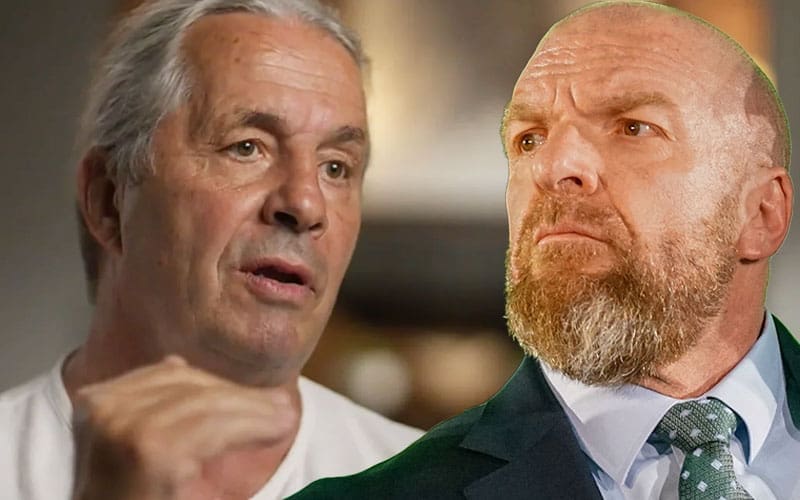
Bret Hart has never been one to mince words, but his latest comments have set the internet wrestling community on fire. Speaking at a live Inside The Ropes event, the WWE Hall of Famer completely tore into the in-ring legacy of Paul "Triple H" Levesque. Hart declared that he never saw anything special in the multi-time world champion and never wanted to step in the ring with him.
The Hitman did not just criticize Levesque's style; he dismissed his entire career catalog. According to Ringside News, the legendary Canadian technical specialist claimed he could always visualize a great story when looking at other elite performers. But that creative spark was completely non-existent whenever he watched Levesque perform.
“There’s not one match that I ever watched of Triple H with anybody that I ever thought was, ‘Oh, that’s a great match.’ I never, ever wanted to wrestle him.”
This is a staggering teardown of a performer who headlined multiple WrestleMania events and anchored WWE’s main-event scene for over a decade. Hart's critique strikes at the heart of Levesque's identity as a self-proclaimed student of the game. For a guy who built his brand on epic, long-form matches, being told none of them are actually great is a massive professional blow.
This in-ring history contrasts sharply with Levesque's current executive role, where his booking decisions shape the entire product. His creative regime has faced its own share of backstage drama under TKO management, such as when Vince Russo blamed Levesque for the contract breakdown that led to Sheamus' recent WWE departure.
The Raw History and Ring Chemistry Deficit
Hart and Levesque did cross paths on television back in 1997, when Levesque was still performing as the blue-blood Hunter Hearst Helmsley. They wrestled to a double countout on the June 23, 1997 broadcast of Raw is War, followed by Helmsley scoring a countout win on September 29, 1997. Hart recalls these matches not as collaborative efforts, but as frustrating struggles against an opponent who did not understand the cooperative nature of the business.
“With Triple H, it was always just a match. Nothing special ever came to my mind. I wrestled him a couple of times. He was always trying to beat me.”
In the wrestling business, accusing an opponent of "always trying to beat me" is a quiet way of calling them selfish in the ring. A great match requires two performers working in unison to create drama, not one guy trying to look dominant at the expense of the story. Hart’s criticism suggests Levesque was more interested in protecting his own standing than elevating the collective performance.
This selfish reputation followed Levesque into his infamous "Reign of Terror" on Monday Night Raw in 2003, when he held the World Heavyweight Championship hostage. Performers like Booker T and Rob Van Dam had their red-hot momentum halted by clean pinfalls to the Pedigree. While Levesque was busy cementing his top spot, the actual quality of the weekly broadcasts suffered from repetitive, heat-killing finishes.
A Direct Challenge to the Fans
Hart did not stop at his own experiences; he extended his critique to Levesque's entire body of work. The former five-time WWF Champion challenged fans to name a single match featuring Levesque that belongs in the pantheon of all-time greats. It is a bold dare aimed at a fan base that spent years defending Levesque's classic encounters.
“He was never a horrible wrestler or anything like that, but name one match to me where you’d say, ‘When you go home, find this match and watch Triple H versus somebody.’ I don’t know of one match that I ever wanted to watch back.”
Wrestling purists will immediately point to the legendary Street Fight at the Royal Rumble in 2000 against Cactus Jack. That match featured a pedigree onto thumbtacks and a back-body drop through the announcers' table at 26 minutes, cementing Levesque as a tough champion. Others will argue for the Unsanctioned match at SummerSlam 2002 against a returning Shawn Michaels, which remains a masterclass in emotional storytelling.
But Hart’s point is that these matches succeeded because of the extraordinary efforts of Levesque's opponents, rather than Levesque himself. Mick Foley took incredible physical punishment, and Michaels returned from a four-year retirement without losing a step. In Hart's eyes, Levesque was simply the passenger in these legendary bouts, benefiting from the genius of others.
Clashing Philosophies and the Montreal Shadow
This dispute exposes the fundamental division between two distinct eras of professional wrestling. Hart represents the physical realism of the Hart Dungeon, where every wristlock and Irish whip looked like a genuine athletic contest. Levesque’s style was built on the slower, punch-and-kick template of Harley Race, often bloated by run-ins and weapon spots.
Yet, it is impossible to separate Hart’s technical critique from the bitter history of the Montreal Screwjob on November 9, 1997. Levesque was reportedly one of the key voices urging Vince McMahon to steal the title from Hart without his knowledge. That real-life betrayal shattered locker room trust and created a permanent rift between the two legends.
Real journalism requires noting that Hart’s evaluation is heavily colored by this decades-long grudge. While he praises Shawn Michaels' talent despite their personal hatred, he refuses to extend the same grace to Levesque. It is a critical blind spot in Hart's analysis, as Levesque's work with Cactus Jack or Daniel Bryan at WrestleMania XXX proved he could deliver under pressure.
At the same time, Hart’s own late-career booking decisions were far from perfect, including the embarrassing WrestleMania 26 match against Vince McMahon that went 11 painful minutes. While Hart continues to protect his legacy as the best there is, his critics will point to these tarnished outings. The wrestling world remains divided, but Hart has ensured the debate over Levesque's actual greatness will continue to rage as WWE builds toward major events like SummerSlam 2026.