
How John Cena mastered the quiet art of the WWE locker room
The End of the Franchise
John Cena did not leave a void when he walked away. After his final match against Gunther at Saturday Night's Main Event, the curtain came down on a career that spanned more than two decades. Most wrestling legends drag their exit out with multiple tearful retirements, but Cena went home to think about death.
It sounds like a grim way to spend a retirement. Yet, Cena is at peace. He spent his final media tours rejecting the typical locker room nostalgia in favor of a factual view of human mortality.
The match against Gunther was a fitting final chapter. Gunther is a brutal minimalist who relies on heavy chops and basic suplexes to break his opponents. Cena met him not with athletic spots, but with the pacing of an old-school technician who knew his body was at its limit.
To understand why Cena is so content to walk away, you have to look at how he ran his matches. He was never a high-flying performer who risked his neck for a cheap pop. He was a mechanical storyteller who treated the ring like a theatrical stage.
This clinical approach was often criticized by hardcore fans who wanted more work-rate and fewer catchphrases. They wanted twenty-minute classics filled with head-drops and suicide dives. But Cena understood that those bumps were a fast track to the operating table.
The Shakespeare Code
Early in his career, Cena found an unexpected mentor in Booker T. The WCW legend saw potential in the young performer but knew he needed to slow down. The two developed a shorthand word to keep their in-ring work grounded.
They called it "Shakespeare" or "Shakespeare baby." The word was a silent prompt during their matches. It was a reminder to focus on the pacing, the pauses, and the underlying logic of the match.
The philosophy rested on three core elements:
- Pacing the match to give the audience time to react.
- Establishing a clear dramatic reason for every physical move.
- Focusing on character psychology rather than high-risk stunts.
For Cena, a wrestling match was never about the physical complexity of the moves. He believed that executing great physical feats without a narrative purpose was worthless. If a move did not have a clear reason behind it, it was just empty noise.
This philosophy stood in direct opposition to the modern indy style of rapid-fire maneuvers. Cena watched younger performers run from spot to spot without letting the audience process the damage. He believed that a match should breathe, allowing the crowd to digest every near-fall and submission hold.
His critics often mocked his limited repertoire, calling it the "five moves of doom." But Cena knew that those five moves drew more money than a hundred flips. He understood that the crowd reacted to the story, not the acrobatics.
He taught this lesson to everyone who would listen. He told them to stop rushing. He wanted them to realize that the space between the moves was where the drama actually happened.
The Gifted Rivals
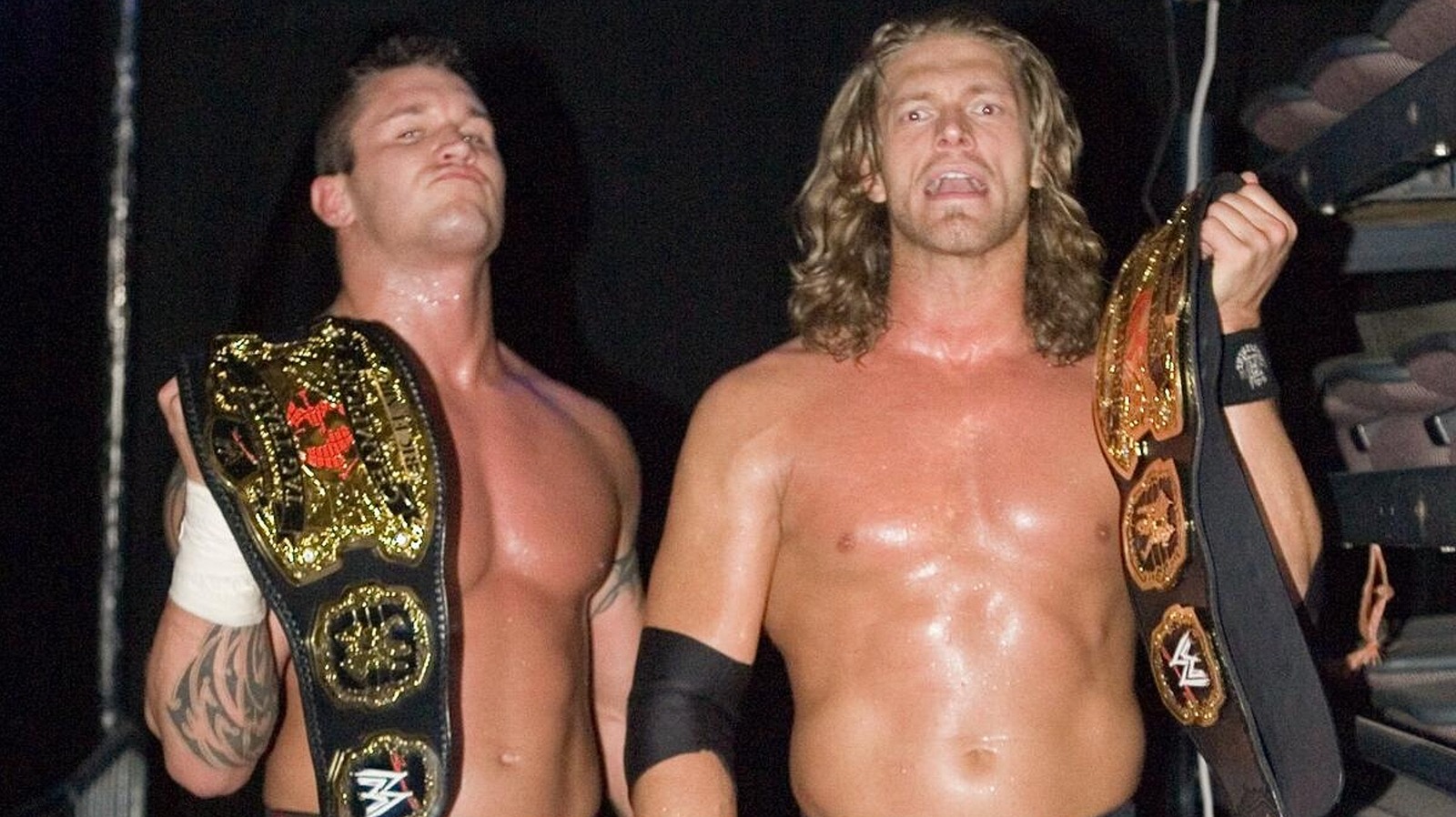
This structural focus is why Cena recently singled out his two greatest opponents. Speaking at SpaceCon, as Wrestling Inc reported, Cena named Randy Orton and Adam Copeland as his definitive rivals.
"There's not much more of a creative mind for the business than Adam Copeland. He is all about pro wrestling, and I don't think there's a person that makes this business look easy or easier than Randy Orton."
He described them as gifted performers who approached the business from opposite directions. Copeland was the ultimate creative mind, mapping out complex narratives. Orton, by contrast, was an absolute natural who made the most difficult movements look effortless.
The careers of these three men have remained linked even as they split across competing promotions. Copeland, now working as Edge in AEW, paid tribute to Cena during a tag match alongside Christian Cage against FTR at All Out Toronto 2025.
During the match, Copeland hit both the Five Knuckle Shuffle and the Attitude Adjustment on Cash Wheeler. The Toronto crowd erupted, recognizing the nod to Cena. It was a public acknowledgment of the bond they forged during their legendary 2006 feud.
Meanwhile, Orton was unable to attend Cena's final match because he was away in Riyadh, Saudi Arabia. Still, he posted a lengthy social media statement thanking Cena for his locker room leadership and his personal kindness.
These gestures reflect a mutual respect built on in-ring psychology. None of these three men relied on high-flying stunts to draw money. They built their matches on facial expressions, timing, and crowd manipulation.
They understood that a great heel needs to make the babyface look like a hero. When Orton hit his RKO or Copeland delivered a spear, it was the culmination of twenty minutes of struggle. It was storytelling at its highest level.
The Backstage Rescues
That shared intelligence often put them at odds with the corporate creative team. When Copeland was tasked with starting a new faction in WWE in April 2022, Vince McMahon wanted something identical to The Brood.
Copeland had different plans, selecting Rhea Ripley and Damian Priest instead. He knew they had the raw talent to carry the company.
As Adam Copeland revealed, McMahon was surprised by the pitch. The boss simply did not see what he had in those two future stars, which Copeland thought was a shame.
The Judgment Day went on to become the most consistent element of WWE television, but it succeeded because of Copeland's initial foresight. Ripley eventually became the Women's Champion, and Priest took the WWE Tag Team Championship alongside R-Truth.
The faction underwent multiple changes, including the addition of Finn Balor, who eventually turned on Copeland. Dominik Mysterio was brought in by Ripley, turning on his father Rey Mysterio to become a massive heel.
It was a classic example of creative intuition overriding corporate formula. Cena had his own history of rescuing talent from bad corporate booking.
Back in 2012, Enzo Amore made his NXT debut and was promptly buried by the trainers. He was given a standard squash match under Triple H's developmental booking, and trainer Bill DeMott tore into him afterward.
As F4WOnline reported, Rob Naylor stopped Amore in the NXT parking lot to tell him Cena wanted to see him.
Cena told Amore he was the only thing that had caught his attention in three hours of watching tapes. He invited Enzo to join him in a dark segment that night.
Amore immediately asked if he could bring his tag partner, Big Cass. The catch was that they were not actually a tag team yet in 2013. They were just friends, and Cass was quietly teaching Enzo the basics of psychology and gimmicks.
Cena agreed, and the subsequent dark segment gave the duo the rub they needed to survive NXT. Without Cena's intervention, one of the most popular tag teams of the era would have been cut before they ever reached television.
The NXT developmental system was often a factory of conformity. It took an established star like Cena to break the rules and save a unique talent from being discarded.
Broken Trust and Simple Money
Still, Cena's own path was not without its moral failures. In a separate NPR interview, Cena admitted that his personal ambition once led him to violate McMahon's trust.
He attempted to join an entrepreneurial social network startup without informing his boss. It was a risky move that could have jeopardized his career.
He wanted to secure a massive payout, pure and simple. There was no creative motivation behind the deal.
Because of his status, joining the startup meant utilizing WWE's valuable intellectual property. When McMahon found out, he did not go nuclear.
Instead, McMahon walked him through the consequences of the decision. Cena recalled that McMahon showed patience and tolerance in a moment where he could have easily destroyed their working relationship.
The admission shows the double standard that defined Cena's career. While he helped underdogs like Enzo Amore, he remained fiercely protective of his own corporate standing and financial gains.
He was a company man who occasionally tried to cheat the system for a personal payday. When caught, he fell back into line, proving that his loyalty had a clear price tag.
The Factual End
This realism is what makes Cena's transition to retirement so clean. He has spent years looking at wrestling as a business of narrative and metrics rather than an emotional obsession.
As a young performer, Cena used to joke that he would not survive past 40. He used that prediction as cannon fodder to chase cheap dopamine hits and quick thrills.
Now, he views mortality as a factual reality. He has stated that thinking about death gives him gratitude for the present.
"We all think we got all the time in the world. And I think when you realize you don’t, it helps you appreciate the time you have, at least from my perspective."
There is no void to fill because the WWE chapter was a finite project. He is not looking for a new obsession to replace the noise of the arena.
The matches are over. The stories have been told. For Cena, the curtain is down, and the silence is exactly what he planned.
He leaves the business on his own terms, having mastered both the art of the story and the reality of the corporate machine.
Becky Lynch: The Man: Not Your Average Average Girl by Becky Lynch
An unfiltered, raw, and incredibly inspiring look inside the life of WWE's 'The
Frequently Asked Questions
Who was John Cena's final WWE opponent?
Who mentored John Cena early in his WWE career?
What did Shakespeare mean to John Cena and Booker T?
What were the core elements of John Cena's wrestling philosophy?
Why did John Cena defend his limited wrestling moves?
More Coverage

Why Sami Callihan could be headed to WWE's AAA after TNA exit
3 hours ago
WWE avoids disaster as Liv Morgan escapes serious injury ahead of Saudi show
3 hours ago
WWE is playing it safe with the Night of Champions 2026 card
3 hours ago
Jey Uso is dragging WWE back into its worst Bloodline habits
3 hours ago
TNA is planning a major WWE surprise for Slammiversary
3 hours ago
Jey Uso fires back at WWE fans after rejoining Roman Reigns and the Bloodline
3 hours agoMore Analysis
Why Sami Callihan could be headed to WWE's AAA after TNA exit
3 hours ago
WWE avoids disaster as Liv Morgan escapes serious injury ahead of Saudi show
3 hours ago
WWE is playing it safe with the Night of Champions 2026 card
3 hours ago
TNA Wrestling shuts down sale rumors as Moose tells fans to stop playing analyst
3 hours ago
Sareee is still headed to AEW despite that frustrating medical scratch
3 hours ago