The 146-Day Pivot
On January 31, 2026, AJ Styles was forced into retirement by Gunther under the bright lights of the WWE Royal Rumble. Just 146 days later, on June 26, 2026, his nineteen-year-old son Avery Styles walked through the curtain at the Royston Dome. The transition was remarkably brief, replacing a multi-decade legacy with an untested rookie in less than five months.
This rapid succession is a marketing masterstroke for Squared Circle Action. The promotion drew immediate attention to its Georgia event by placing Avery in a high-profile spot. But beneath the celebratory debut lies a brutal physical reality. The math is simple, and it does not favor the rookie.
AJ Styles finished his active career with a total of 2,363 matches on his ledger. That volume represents twenty-eight years of continuous physical punishment across multiple continents. For Avery to match that legacy, he must sustain a workload that is historically rare. He is starting from scratch in a very different industry.
The Workload Math of a 28-Year Legacy
AJ Styles was a physical anomaly. When he debuted in 1998, the Georgia independent scene was a chaotic testing ground. His early high-flying style in the TNA X-Division was built on high-velocity impact. Wrestlers utilizing that specific aerial approach usually face a steep performance decline by their early thirties.
We saw this exact decline in AJ's early contemporaries. Low Ki and Amazing Red saw their bodies break down under the weight of high-impact styles. Yet AJ Styles managed to maintain an elite main-event work rate well into his late forties. The mileage adds up quickly.
The numbers behind AJ's career are staggering. Over his twenty-eight years in the ring, he maintained a win rate of 59.9 percent. That level of consistent positioning requires both physical durability and creative value. The final loss at the Royal Rumble was a rare stoppage, ending his career with a 37.4 percent loss rate.
To reach his father's career volume of 2,363 matches, Avery must maintain a pace of 84.4 matches per year. He must do this continuously until the year 2054 to match his father's retirement age of 48. Modern scheduling and increased athletic demands make this projection highly improbable for any rookie starting today. The physical toll of the road is simply too high.
AJ Styles retired at 48 years old after losing a sleeper hold stoppage to Gunther. That retirement ended a grueling run that spanned Ring of Honor, TNA, New Japan Pro-Wrestling, and WWE. Avery starting at 19 gives him a head start in years, but not necessarily in durability.
The Mechanical Risk of the Styles Clash
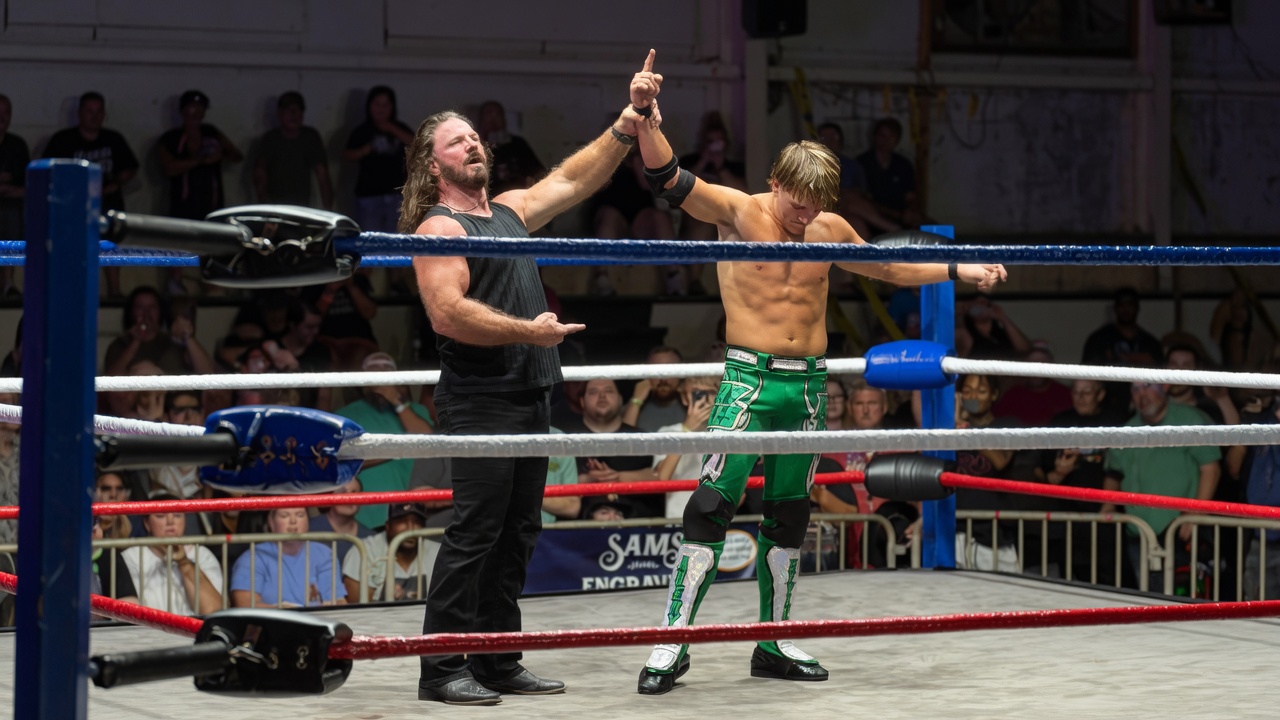
Avery Styles made his professional debut against Ashton Martin in the main event of the Squared Circle Action show. The match concluded with a heavy dose of family nostalgia. AJ Styles came down to assist his son, helping him deliver the Styles Clash for the pinfall victory. It was a classic local pop.
This sequence was a crowd-pleaser in Georgia. However, building a nineteen-year-old rookie's identity around the Styles Clash is a high-risk tactical decision. The move is one of the most mechanically unforgiving finishers in professional wrestling history. The assist is a crutch.
Unlike standard maneuvers, the Styles Clash requires the victim to fight their natural instincts. In almost every other bump, a wrestler must tuck their chin to protect the cervical spine. Taking the Styles Clash requires the exact opposite. The performer must keep their head back and look up, landing flat on their chest. The geometry is dangerous.
A fraction of a second of hesitation from either wrestler can result in a catastrophic neck injury. We have seen seasoned veterans suffer severe cervical fractures from taking the move incorrectly. Trusting a rookie to execute this move in his debut is a massive safety gamble. The risk profile is extreme.
The reliance on AJ Styles for physical assistance also creates an immediate narrative problem. A rookie cannot establish credibility if his primary offensive weapon requires a retired legend to run in. Avery must establish his own signature offense to survive on his own merits.
The Historical Reality of the Second-Gen Bell Curve
The history of professional wrestling is littered with second-generation performers who collapsed under the weight of their family names. For every Randy Orton, there are multiple performers like David Flair, Ted DiBiase Jr., and Curtis Axel. These wrestlers were pushed too fast based on name recognition alone. The name becomes a trap.
The performers who succeeded did so by breaking away from their fathers' identities. Randy Orton debuted in WWE developmental at 20 but did not spend his career copying Cowboy Bob Orton's superplex. Cody Rhodes had to completely abandon the dusty charisma of his father to find his own main-event persona. They carved their own paths.
As reported by Wrestling News, the young wrestler competes under his father's famous surname. Avery Styles appears to be leaning heavily into his dad's past, entering the arena to 'DemiGods,' AJ's old Ring of Honor theme. While this creates a warm reception in Georgia, it limits his room for creative growth.
Wrestling history shows that direct duplication has a rapid rate of decay. If Avery remains a cover act for his father's greatest hits, the novelty will quickly wear off. The modern audience is too analytical to accept a tribute act as a legitimate main-event star. He needs a distinct voice.
The Spatial and Physical Projection
Refining spatial awareness requires years of repetitive ring work. Unlike Charlotte Flair or Bron Breakker, who entered the industry after elite collegiate sports careers, Avery is entering directly from training. He lacks the luxury of a structured developmental system like the WWE Performance Center. The training wheels are off.
The Royston Dome is a demanding environment for a teenager. Working independent shows means wrestling in front of small crowds with varying ring qualities. These rings often lack the standardized bounce and safety features of major promotions, increasing the physical toll on a young body. The impact is harder.
Avery's filing to trademark 'Avery Styles' on June 29, 2026, shows a keen business mind. Protecting the brand early is smart. Yet a trademark filing cannot protect a rotator cuff or a meniscus from the wear of eighty matches a year. Legality does not prevent injury.
The physical style that AJ Styles popularized is simply not sustainable for a modern performer without world-class athletic genetics. Avery must adapt his style to emphasize position and timing over high-velocity aerial maneuvers. This change is necessary if he wants to survive his twenties. He cannot fly forever.
Breaking the Generational Cycle
The nineteen-year-old has the advantage of his father's guidance in the corner. AJ Styles' presence at the Squared Circle Action event showed he is fully invested in his son's career. But the physical work inside the ropes must be done alone. The spotlight is hot.
The 146-day transition from AJ's retirement to Avery's debut was a sentimental success. It gave Georgia fans a moment of closure after the Rumble. However, sentimentality does not win championships or protect joints. The business is cold.
Avery Styles has a long road ahead to prove he is more than a famous surname. The numbers are clear. To build a lasting legacy, he must step out of the shadow of the Styles Clash and write his own formula. The clock is already ticking.