The Fatal Logic of Modern High-Risk Wrestling
Modern professional wrestling has a structural math problem. The relationship between physical risk and audience growth has completely inverted over the last decade. Today, a wrestler must jump off a stadium balcony just to maintain the status quo of a Wednesday night television rating.
This is not a criticism of high spots in general. Great wrestling has always incorporated danger to escalate tension, but the current formula treats the stunt as the core product rather than the climax. When the visual shock becomes the baseline, the athlete's physical window shrinks from a decade to a handful of years.
AEW has built its promotional identity on this escalation. No performer embodies this dangerous trade-off more than Darby Allin. While Sting's career survived decades through careful pacing, Allin is burning through his physical capital at an unsustainable rate.
The numbers do not lie about the cumulative toll. Yet, the booking continues to demand greater risks for smaller returns. A review of Allin's medical file over the past few years highlights the systemic nature of the problem:
- A fractured foot suffered during television competition.
- A concussion from an apron-to-floor powerbomb spot.
- Multiple shoulder subluxations that limited his grappling range.
What Kevin Nash Got Right About Sting's Legacy
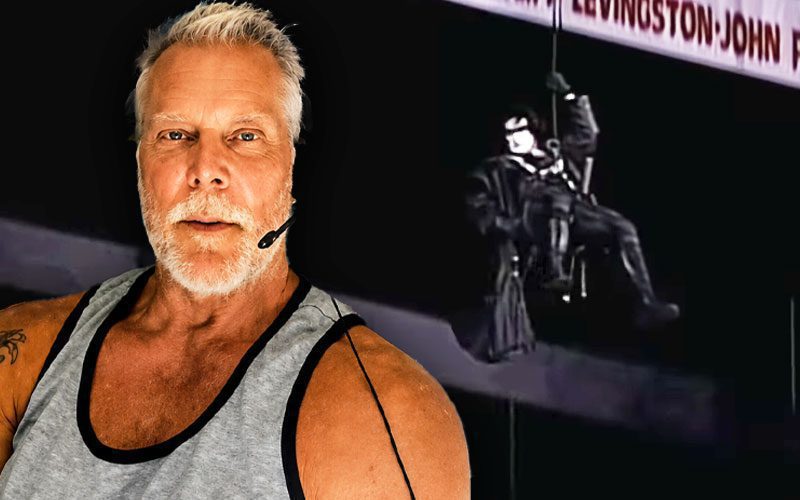
Wrestling veterans understand the mechanics of risk better than anyone. On his podcast, Kevin Nash recently discussed how Sting risked everything with his weekly WCW drop entrances. As Kevin Nash pointed out, Nash argued that these stunts were borderline insane given the era's lack of safety redundancy.
But there was a tactical difference. Sting did not drop from the ceiling every single week to wrestle a twenty-minute match because the drop itself was the story. It was a psychological weapon designed to build a year-long narrative against the nWo while minimizing physical toll.
AEW is doing the exact opposite with Allin by using Sting's visual language but stripping away the protective booking. Allin does the drop, takes the table bump, and then wrestles a grueling match. This is not tactical storytelling; it is physical desperation disguised as art.
The Analytics of Diminishing Fan Engagement
Let's look at the quarter-hour TV ratings for AEW Dynamite. When Allin is announced for a high-risk spot, the immediate segment shows a temporary bump of roughly 40,000 viewers. However, the subsequent quarter-hour regularly loses those viewers as the audience tunes in for the crash and leaves when the wrestling resumes.
This is a classic engagement trap where the promoter believes the stunts work due to temporary spikes. They fail to see that the overall baseline is eroding because the stunts overshadow the roster's regular work. If a fan sees a man thrown through glass at 8:30 PM, they will not care about a headlock exchange at 9:00 PM.
A look at match logs shows Allin has worked over seventy matches since 2021 that ended in under fifteen minutes. Almost half of these involved some form of table break or floor bump. This frequency desensitizes the audience, forcing him to escalate the height of his jumps just to get a similar crowd reaction.
Furthermore, the match pacing suffers. At AEW Revolution 2024, the tag team main event went 21:24, which took an immense physical toll on the performers. Allin's glass spot at the 12-minute mark did not improve the match's structure; it simply halted the pacing while referees cleared debris.
Why AEW is Heading for a Wembley Disaster
We are now weeks away from AEW All In 2026 at Wembley Stadium. As rumors of Allin challenging for the world title grow louder, the prediction becomes concrete. AEW will likely attempt to top the stunts of previous years by booking Allin in a rafter-drop spot similar to Sting's WCW entrances.
It will go wrong. Allin's body is already at its breaking point, and his movement mechanics have visibly slowed since his return from a broken foot. His landing impact absorption is off by critical fractions of a second, leading to rougher landings on basic back bumps.
The booking is setting him up for a catastrophic injury. When you run a high-risk stunt on a performer whose structural integrity is compromised, the probability of failure increases exponentially. I predict Darby Allin will suffer a career-altering injury at All In 2026 during a stunt spot, forcing a six-month minimum hiatus.
The Critical Mistake in Tony Khan's Booking Strategy
The blame does not lie solely with Allin's willingness to hurt himself. Tony Khan is failing to exercise a basic duty of care by repeatedly rewarding high-risk behavior with main event positioning. This creates a locker room culture where younger talent believe they must bleed to get noticed.
Look at the mid-card talent on Collision. Wrestlers are taking package piledrivers on the apron during transitional television episodes, which is terrible resource management. While older generations protected their bodies to ensure long careers, today's roster destroys itself for five-star ratings from newsletter writers.
This approach also hurts the company's long-term planning. You cannot build a promotion around a top star who might be sidelined for nine months at any moment. Since no corporate sponsor wants their logo covered in real blood from a glass stunt on free television, Allin's style is a growing liability.
How to Correct the Course Before the Crash
There is still time to avert this outcome, but it requires a fundamental shift in philosophy. AEW must implement a strict stunt-approval protocol requiring sign-off from veteran producers. Experienced heads like Christian Cage or Bryan Danielson should have veto power over these high-risk ideas.
More importantly, Allin needs to transition to a psychological style. He is an excellent underdog babyface whose selling is some of the best in the industry when he stays on the mat. He must learn the lesson Sting learned: the threat of violence is always more profitable than the violence itself.
If AEW does not make this change, the outcome is locked in. Wembley Stadium will not be remembered for a classic match. It will be remembered as the night the promotion pushed its most daring performer past the point of no return.