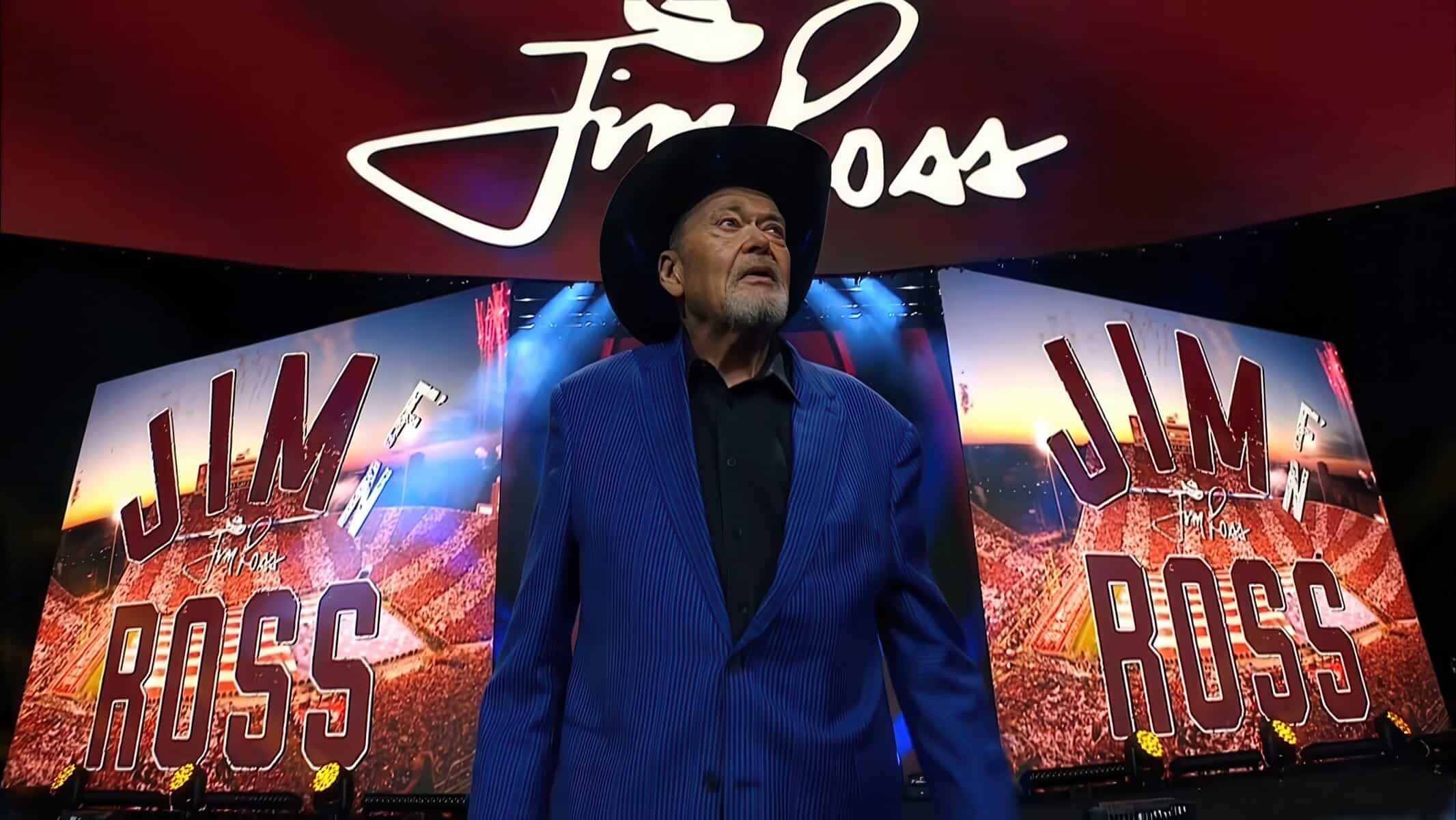
The Norman Interregnum and the August Countdown
Over 30 days in a Norman, Oklahoma hospital. For Jim Ross, who has spent 52 years traveling the professional wrestling highway, this month-long confinement represents a rare and jarring halt. As WrestlingNews.co reported, the legendary broadcaster is finally heading home on June 30, 2026.
This discharge ends his longest physical absence from the industry in five years. His 2021 skin cancer treatment was his previous benchmark, sidelining him for 28 days.
The timeline of this release is not just a personal victory. It sets a ticking clock for his professional future. In August 2025, Ross signed a one-year contract extension with All Elite Wrestling.
That deal is scheduled to expire in August 2026. This leaves exactly 62 days to determine whether the most recognizable voice in wrestling history will retire or sign another short-term extension. With his health forcing prolonged absences, the numbers suggest his era has already drawn to a close.
AEW's commentary structure has evolved to function entirely in his absence. His televised appearances have declined by over 95% since the company's inception. The promotion has constructed a booth that no longer requires his presence.
He remains as a highly paid legacy act. However, the return on investment is diminishing. The statistics of his decline tell the story of an inevitable transition.
The Quantitative Decline of the TV Voice
When AEW launched weekly television with Dynamite on October 2, 2019, Ross was the centerpiece of the broadcast. He called 100% of the two-hour weekly show alongside Excalibur and Tony Schiavone. His voice anchored 120 minutes of national television every single week.
He was the primary narrator for the company's foundational stories. He voiced Chris Jericho's inaugural title run and Cody Rhodes' early babyface promos.
That workload began to decline in late 2021. With the launch of the one-hour Rampage and Ross's health issues, AEW adjusted his schedule. By mid-2022, he called only the second hour of Dynamite and the taped Rampage broadcast.
This reduced his weekly televised output to 70 minutes, a 41.6% reduction from his original role. It was the first structural admission that the weekly grind of television was becoming unsustainable.
The launch of Collision in June 2023 accelerated this trend. By early 2024, Ross's television presence was almost completely gone. He transitioned to a "special attraction" role, calling only 1 or 2 marquee matches on pay-per-views.
In the first half of 2026, he called exactly three matches on AEW television. Out of approximately 130 hours of televised AEW programming in 2026, Ross was on air for less than 45 minutes. This represents a minuscule 0.57% broadcast footprint.
The Pay-Per-View Contraction
Even on pay-per-view, his presence has shrunk to a fraction of the card. AEW has expanded its pay-per-view schedule, running 9 major events in 2025 compared to its original four-show model. Yet, Ross's workload on these shows moved in the opposite direction.
At AEW Double or Nothing in May 2026, Ross called only the main event. This represented exactly 10% of the ten-match card. It is a stark contrast to his past workloads.
This is a sharp departure from his WWE heyday. At WrestleMania 17 in 2001, Ross called every single match of the 11-match card over a four-hour broadcast. At AEW's Revolution 2024, he called only Sting's retirement match, which occupied 22 minutes of a four-hour show.
He is no longer building the narrative of an entire event. Instead, he is a specialized closer. He is brought in to call the final match and provide a nostalgic wrap-up.
The Quality Crisis of the Multi-Man Booth
The reduction in Ross's hours has exposed a fundamental structural issue in AEW's commentary. In the Attitude Era, Ross and Jerry Lawler operated as a classic two-man booth. This setup allowed for a division of labor: Ross handled play-by-play while Lawler provided color commentary.
The division of speech-share was roughly 60-40 in Ross's favor. This allowed him to control the pace, call the moves, and build to dramatic crescendos.
AEW has rejected this model in favor of three-man and four-man booths. The combination of Excalibur, Tony Schiavone, and Taz frequently degenerates into a chaotic exchange of inside jokes and overlapping banter. Without Ross's commanding presence to anchor the broadcast, the commentary team struggles with basic pacing.
They often talk over each other during critical high-spots. The audience is left overwhelmed by noise rather than guided by narration.
Yet, Ross's occasional returns have not been without flaws. Physical decline has affected his play-by-play precision. During his limited appearances in late 2025 and early 2026, Ross repeatedly misidentified moves.
He has called a springboard cutter a simple headscissors and lost track of legal men in tag matches. The sharp, split-second reactions that defined his work in the 1990s are gone. In their place is a slower, sometimes confused delivery that active viewers find distracting.
Heading home tomorrow! Over 30 days in the hospital come to a grateful end. Count your blessings daily
The Illusion of the Big Match Bump
Despite these visible struggles, there is a counterintuitive statistic that Tony Khan frequently uses to justify Ross's position. According to data from public wrestling review databases, the matches Ross calls on AEW pay-per-views carry a significantly higher rating than the matches he does not.
Of the 18 pay-per-view matches Ross called between January 2024 and May 2026, the average user rating was 8.61 out of 10. The matches on those same cards that he did not call averaged just 7.42. This represents a significant 1.19-point delta.
This difference suggests that Ross's voice elevates a match to classic status. However, a deeper analysis reveals this is a classic case of selection bias. Ross does not make the matches better.
Instead, he is assigned to matches that are already guaranteed to succeed. He is shielded from cold mid-card matches and reserved exclusively for headlining main events with months of television build, such as Sting's final match or Swerve Strickland's title defenses.
When Ross called Sting and Darby Allin vs The Young Bucks at Revolution 2024, the match was already positioned as the most emotional night in the company's history. Ross did not have to work to get the crowd invested. The average rating is a trailing indicator of booking priority, not a measure of Ross's broadcasting effectiveness.
The numbers show he is a passenger on these great matches, not the driver. This selection bias makes it look like his voice is doing the heavy lifting, when in reality, the booking is doing the work.
The Financial Reality of Legacy Contracts
This brings us to the financial reality facing AEW management. Reports from PWInsider indicate that Ross's contract is one of the most lucrative commentary deals in the industry.
For a broadcaster who calls less than 1% of the company's weekly televised output, the cost-per-minute of airtime is astronomical. In a period where AEW is negotiating its next media rights deal and looking to streamline production costs, this legacy expenditure is difficult to justify.
AEW has already built its future voice. Excalibur has called over 98% of all AEW matches since the company's inception. While his rapid-fire, move-heavy style lacks the emotional resonance of Ross's classic work, it matches the product that AEW presents on screen.
Keeping Ross on the payroll for a handful of pay-per-view matches per year is a sentimental luxury. It is not a strategic necessity.
As F4WOnline noted, Ross's hospital stay is almost over, but his time as a regular contributor is already behind him.
When his contract expires in August 2026, AEW must resist the urge to sign another one-year extension. It is time to let the final bell ring on a historic career.